
Advice for Sky Watchers
Going to a dark sky site and want to see if you can find your way around the sky, or connect with nature at night, as our ancestors did? Here is some basic how-to advice:
- Dress warmer than you think. We moderns are not used to being outside at night. Dress in layers for twenty degrees colder than the anticipated temperature. That way, you can adjust. Don’t leave the gloves and knit cap behind unless it is late spring or summer.
- You need a red or amber flashlight. It takes 20 minutes or more for human eyes to fully dark-adapt, and a few seconds of white light will erase the gain. Place a red balloon over a white flashlight, use red-tinted film from an auto supply or arts-and-crafts store, or just buy a red light. The darker the sky and the better your eyes are adapted, the more stars you will see.
- A sky map is essential. For beginners, download the current Monthly Sky Map. It is the best option for actually starting to learn the sky. The Sky Maps are published monthly and show how the sky will appear each evening. Planetarium programs for phones and tablets can be fun, but you will not learn the sky as readily as using a map and star hopping from constellation to constellation. Use digital apps in the red light mode.
- Where to start. There is one place in the sky that never moves. The Earth’s axis of rotation goes right by Polaris, making it the North Star and therefore always in the same place in the sky. Your fist held out at arm’s length subtends ten degrees. Here in Central Arkansas, we are 35 degrees north of the equator. So, Polaris will be 35 degrees above the northern horizon – three and a half fists above a flat horizon. Polaris is the end star in the handle of the Little Dipper.
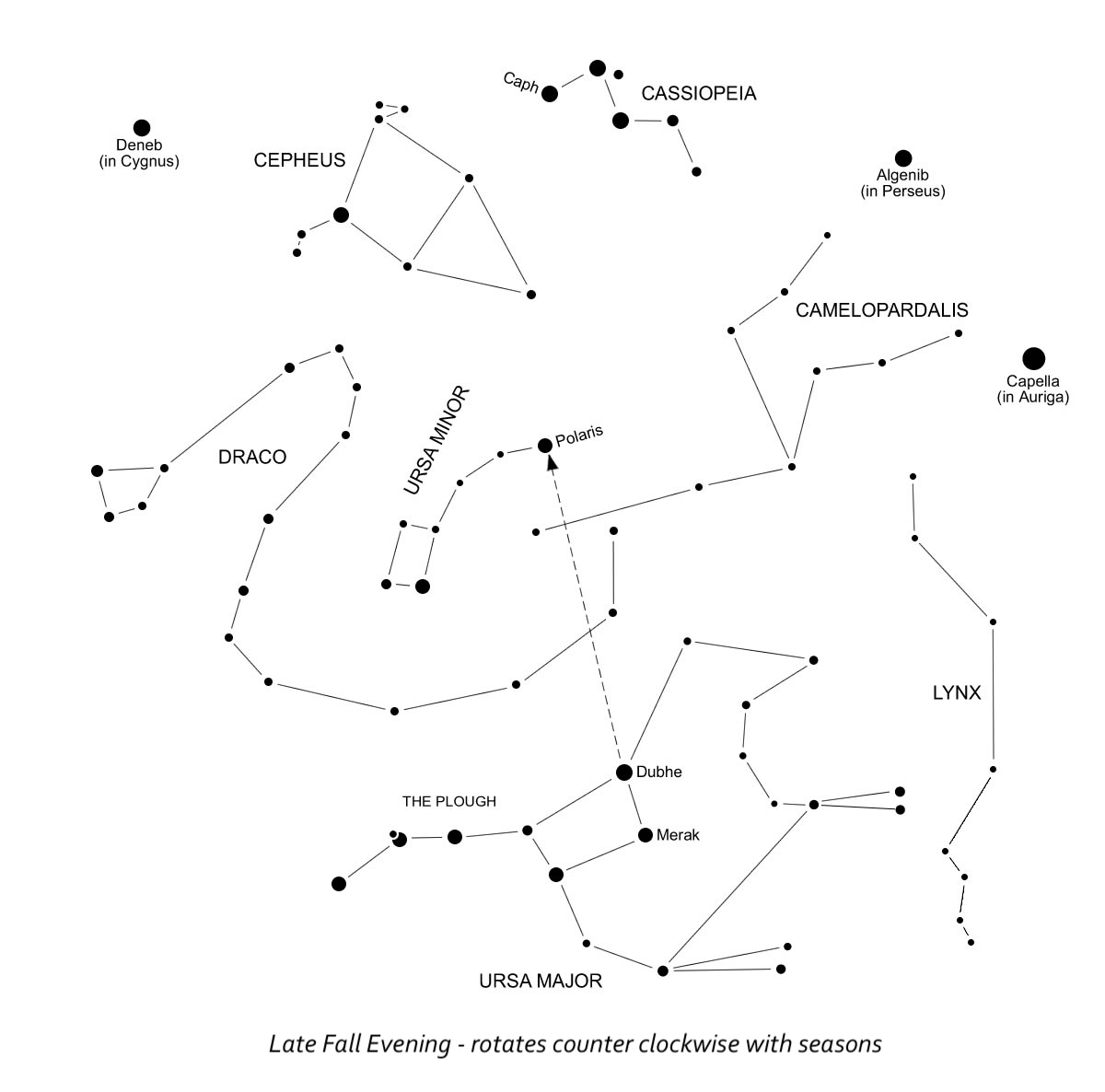
- Start star hopping. Once you think you have found Polaris, look at your chart and find the Big Dipper; if it is not hidden behind obstructions on the Northern horizon, the “pointer stars” (end stars of the dipper) will point at Polaris, confirming you have found it. Cassiopeia is on the opposite side of Polaris from the Big Dipper and lies in the Milky Way. If Cassiopeia is on the west side of the dipper, the Winter Milky Way is up and will arch across the sky from Cassiopeia. If on the East side, the Summer Milky Way is up. If Cassiopeia is down, near or below the northern horizon, then the Milky Way is not up, and you are looking perpendicular to the galactic plane.
- Keep going. From there, it should be just a matter of comparing your map to the sky to “star hop” from one bright star and constellation to the next. A pair of binoculars can be made good use of after you have found your way around the sky.
- But very Important! Do yourself and everyone else a favor. Share your experience on ANSA’s Facebook Group page. If you were in a cabin or campground, review the accommodations and your sky experience. People want to know where they can go to have similar experiences, and it helps us encourage host businesses to care for and promote their skies. So, please don’t forget.
PS You can get a handy red keychain light with neck lanyard (note the batteries can be replaced in these) in ANSA’s online store, along with Learn the Constellations, a handy guide to the night sky when you are ready to move past the simple Monthly Sky Map.